


Robot Polishing System
Industrial Mirror Polishing Buffing Machine
8K Mirror Polishing Machine for Stainless Steel | Eco-Friendly Acid-Free System
Aluminium Plate Coil Mirror Polishing Machine
6K Mirror Buffing Polishing Machine for Metal Surfaces
High-precision metal mirror polishing machine
Pneumatic-pressure 8K Mirror Polishing Machine
Belt-type 8K Mirror Stainless Steel Polishing Machine
High Gloss Mirror Buffing &Polishing Machine
No.8 8K Finishing Mirror Buffing Polishing Machine
Super 8K Mirror Polishing Machine
Industrial Metal Buffing Machine
Titanium Surface Mirror Buffing Machine
Coil To Coil No.4 Finished Grinding Line
Sheet To Sheet NO.4 Finished Grinding Line
Metal Coil Grinding Machine
Metal Sheet Brushing Machine
Copper Polishing Grinding Machine
Titanium Surface Polishing Brushing Machine
Aluminum Plate Polishing Brushing Machine
Stainless No.4 Grinding Machine
Belt Brushing & Grinding Machine
Stainless HL Grinding Machine
Roller HL Grinding Machine
Belt HL Brushing Machine
Dry HL Finishing Machine
Wet HL Finishing Machine
Dry No.4 &HL Grinding Machine Line
Wet No.4 &HL Brushing Machine Line
Scotch-Brite finished Machine For Metal Surface
Scotch-Brite Finished Machine
Stainless Steel Scotch Brite Polishing Machine
Wet Scotch Brite Machine Line
Fully Automatic Scotch Brite(SB) Machine Line
SB Oscillator Machine
SB Grinding Machine
Scotch Brite with Oscillator
Dry Scotch Brite Machine
Four roller Scotch Brite Grinding Machine
Thick Board Stainless Steel Vibration Grinding Machine
Vibration Grinding
Stainless Steel Vibration Grinding Machine
AFP machine
Anti-Fingerprint Roller Coater machine
Anti-Fingerprint Pre-coated machine
Anti-Fingerprint Film Coating machine
Anti-Fingerprint Nano-Coating machine
Precision Sheet Cutting Line for Decorative Metal Processing
Leveling and Precision Cutting Line for Metal Sheet Processing
Automatic Coil Uncoiling
FAQ
By:Lebon
Jul 27,2026
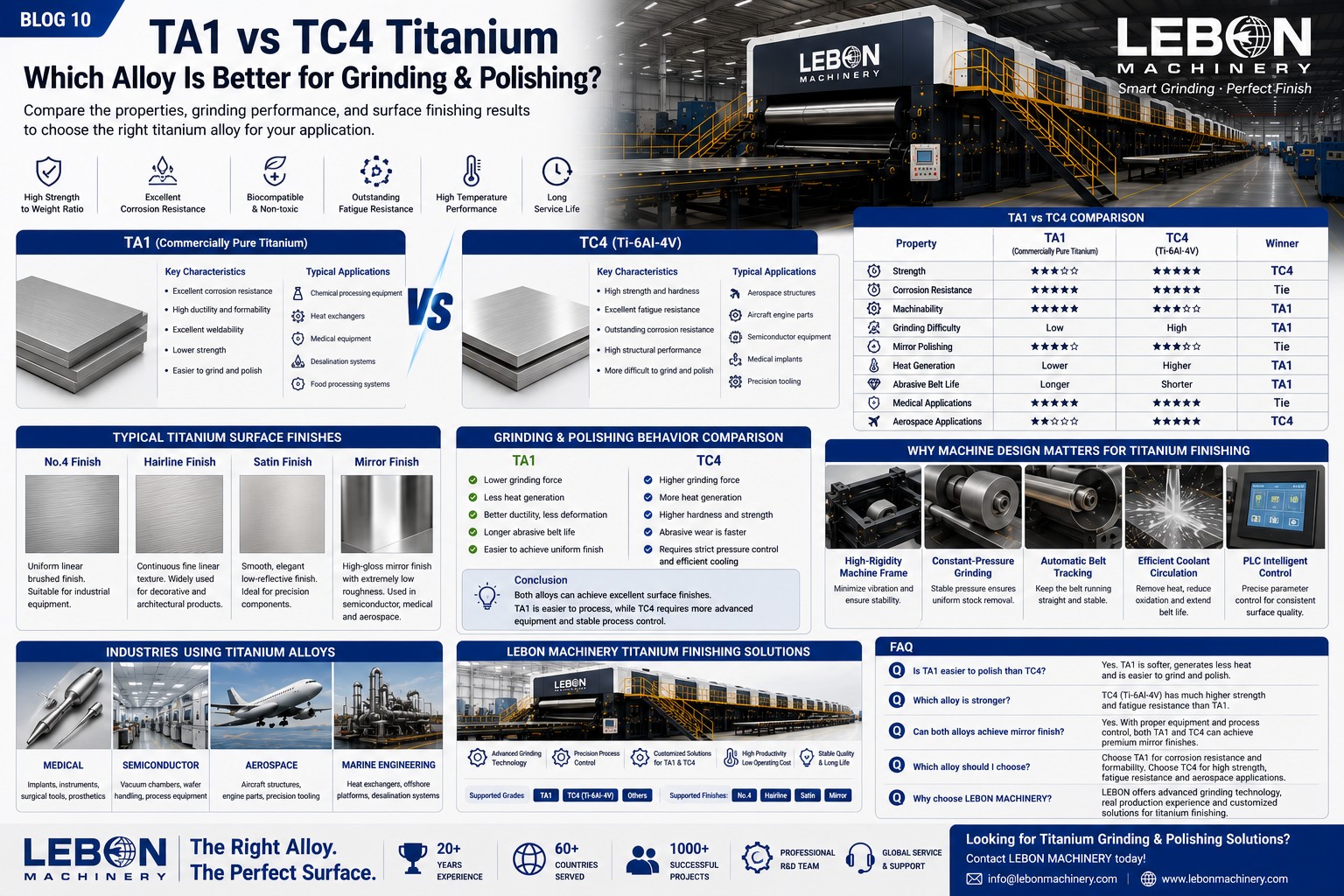
Titanium is widely recognized as one of the most advanced engineering materials available today. However, not all titanium alloys offer the same machining characteristics or surface finishing performance.
Among the many titanium grades, TA1 (Commercially Pure Titanium) and TC4 (Ti-6Al-4V) are the two most commonly used in industrial manufacturing.
Although both provide excellent corrosion resistance and long service life, they differ significantly in strength, hardness, grinding behavior, polishing difficulty, and end-use applications.
Choosing the correct titanium alloy not only affects product performance but also determines grinding efficiency, polishing quality, tooling life, and manufacturing cost.
At LEBON MACHINERY, we help manufacturers optimize titanium grinding and polishing processes for both TA1 and TC4, delivering consistent surface quality for demanding industrial applications.
TA1 belongs to the family of commercially pure titanium.
It contains very few alloying elements, giving it excellent corrosion resistance and good formability.
Excellent corrosion resistance
Outstanding weldability
High ductility
Easy forming
Lower mechanical strength
Better polishing performance
Because of its softer structure, TA1 is generally easier to grind and polish than alloyed titanium.
TA1 is widely used in industries requiring excellent corrosion resistance rather than extremely high strength.
Typical applications include:
Chemical processing equipment
Heat exchangers
Medical equipment
Pharmaceutical machinery
Food processing systems
Desalination equipment
For many corrosion-resistant environments, TA1 provides an excellent balance between performance and manufacturing cost.
TC4 (Ti-6Al-4V) is the world's most widely used titanium alloy.
By adding aluminum and vanadium, TC4 achieves much higher mechanical strength than commercially pure titanium.
High tensile strength
Excellent fatigue resistance
Outstanding corrosion resistance
High hardness
Superior structural performance
These properties make TC4 the preferred material for high-performance engineering applications.
TC4 is commonly used in:
Aerospace structures
Aircraft engine components
Medical implants
Semiconductor equipment
Precision tooling
High-performance industrial machinery
Whenever strength and weight reduction are critical, TC4 is often the first choice.
Although both alloys can achieve excellent surface finishes, their grinding behavior differs significantly.
Advantages
Easier grinding
Better ductility
Lower grinding temperature
Longer abrasive belt life
Higher polishing efficiency
Challenges
Lower wear resistance
Easier deformation under excessive pressure
Advantages
Superior mechanical strength
Better dimensional stability
Excellent fatigue performance
High structural reliability
Challenges
Higher grinding force
Greater heat generation
Faster abrasive wear
More demanding pressure control
Producing premium mirror finishes on TC4 requires advanced grinding technology and stable process control.
Property | TA1 | TC4 |
Material Type | Commercially Pure Titanium | Titanium Alloy |
Strength | ★★★☆☆ | ★★★★★ |
Corrosion Resistance | ★★★★★ | ★★★★★ |
Machinability | ★★★★☆ | ★★★☆☆ |
Grinding Difficulty | Low | High |
Mirror Polishing | Excellent | Excellent (More Difficult) |
Heat Generation | Lower | Higher |
Abrasive Belt Life | Longer | Shorter |
Medical Applications | ★★★★★ | ★★★★★ |
Aerospace Applications | ★★☆☆☆ | ★★★★★ |
Many customers ask whether TA1 or TC4 can achieve a better mirror finish.
The answer is:
Both can achieve premium mirror finishes.
The difference lies in the manufacturing process.
TA1 is generally easier to polish because it generates less heat and offers better ductility.
TC4 requires:
Higher machine rigidity
Precision pressure control
Efficient coolant circulation
Stable abrasive belt tracking
More polishing stages
With the right equipment, both alloys can achieve excellent surface quality.
Titanium polishing demands much greater machine stability than conventional stainless steel processing.
Professional titanium grinding equipment should provide:
High-rigidity machine frames
Constant-pressure grinding
Automatic belt tracking
Efficient coolant filtration
Intelligent PLC control
Stable feed speed
These features help maintain consistent surface quality while reducing abrasive wear and production costs.
LEBON MACHINERY develops advanced grinding and polishing systems for both commercially pure titanium and titanium alloys.
Our equipment supports:
TA1
TC4
Titanium plates
Titanium sheets
Precision titanium components
Surface finishes include:
Mirror Finish
No.4 Finish
Hairline Finish
Satin Finish
With years of practical production experience, we help customers optimize grinding parameters, improve polishing consistency, and increase manufacturing efficiency.
Our titanium finishing solutions are widely used in:
Aircraft structures
Engine components
Precision tooling
Implants
Surgical instruments
Orthopedic devices
Vacuum chambers
Wafer handling systems
Precision process equipment
Heat exchangers
Desalination systems
Corrosion-resistant equipment
Reaction vessels
Pressure equipment
High-purity processing systems
Yes.
Because TA1 is softer and more ductile, it generally produces lower grinding temperatures and offers better polishing efficiency.
TC4 provides significantly higher strength and fatigue resistance than TA1.
Absolutely.
With proper grinding and polishing equipment, both TA1 and TC4 can achieve premium mirror finishes.
Choose TA1 if corrosion resistance, formability, and easier machining are your priorities.
Choose TC4 if your application demands maximum strength, fatigue resistance, and structural performance.
LEBON combines advanced grinding technology with practical production experience, delivering customized titanium surface finishing solutions for manufacturers worldwide.
Both TA1 and TC4 are outstanding titanium materials, but they serve different engineering purposes.
TA1 offers excellent corrosion resistance and easier polishing, making it ideal for chemical processing and medical equipment.
TC4 provides superior strength and fatigue resistance, making it the preferred material for aerospace, semiconductor, and high-performance engineering applications.
At LEBON MACHINERY, we help manufacturers select the right grinding process, polishing technology, and equipment configuration to achieve premium titanium surface finishes with maximum efficiency and long-term reliability.
Whether you process TA1 or TC4, LEBON MACHINERY can provide customized grinding and polishing systems tailored to your material, product dimensions, and required surface finish.
Contact our engineering team today to discuss your next titanium finishing project.
Please, feel free to contact us if you need any further information.
Copyright © Lebon Metal Equipment Co., Ltd. All Rights Reserved.
Design by BONTOP.
 En
En