


Robot Polishing System
Industrial Mirror Polishing Buffing Machine
8K Mirror Polishing Machine for Stainless Steel | Eco-Friendly Acid-Free System
Aluminium Plate Coil Mirror Polishing Machine
6K Mirror Buffing Polishing Machine for Metal Surfaces
High-precision metal mirror polishing machine
Pneumatic-pressure 8K Mirror Polishing Machine
Belt-type 8K Mirror Stainless Steel Polishing Machine
High Gloss Mirror Buffing &Polishing Machine
No.8 8K Finishing Mirror Buffing Polishing Machine
Super 8K Mirror Polishing Machine
Industrial Metal Buffing Machine
Titanium Surface Mirror Buffing Machine
Coil To Coil No.4 Finished Grinding Line
Sheet To Sheet NO.4 Finished Grinding Line
Metal Coil Grinding Machine
Metal Sheet Brushing Machine
Copper Polishing Grinding Machine
Titanium Surface Polishing Brushing Machine
Aluminum Plate Polishing Brushing Machine
Stainless No.4 Grinding Machine
Belt Brushing & Grinding Machine
Stainless HL Grinding Machine
Roller HL Grinding Machine
Belt HL Brushing Machine
Dry HL Finishing Machine
Wet HL Finishing Machine
Dry No.4 &HL Grinding Machine Line
Wet No.4 &HL Brushing Machine Line
Scotch-Brite finished Machine For Metal Surface
Scotch-Brite Finished Machine
Stainless Steel Scotch Brite Polishing Machine
Wet Scotch Brite Machine Line
Fully Automatic Scotch Brite(SB) Machine Line
SB Oscillator Machine
SB Grinding Machine
Scotch Brite with Oscillator
Dry Scotch Brite Machine
Four roller Scotch Brite Grinding Machine
Thick Board Stainless Steel Vibration Grinding Machine
Vibration Grinding
Stainless Steel Vibration Grinding Machine
AFP machine
Anti-Fingerprint Roller Coater machine
Anti-Fingerprint Pre-coated machine
Anti-Fingerprint Film Coating machine
Anti-Fingerprint Nano-Coating machine
Precision Sheet Cutting Line for Decorative Metal Processing
Leveling and Precision Cutting Line for Metal Sheet Processing
Automatic Coil Uncoiling
FAQ
By:Lebon
Jul 27,2026
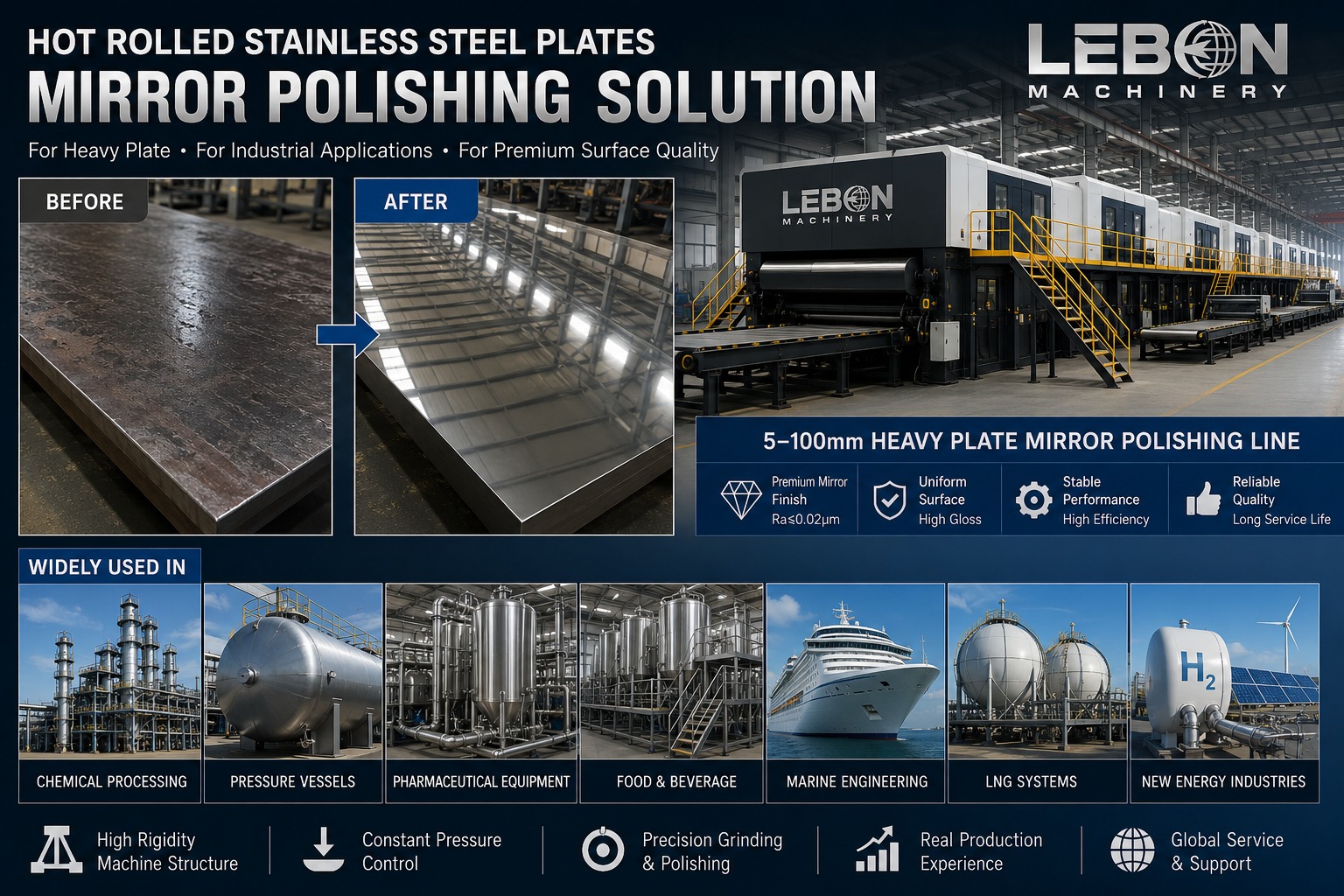
When discussing stainless steel mirror polishing, many people immediately think of decorative stainless steel sheets used for elevators, architectural panels, or kitchen appliances. However, mirror polishing hot rolled stainless steel plates is an entirely different engineering challenge.
Unlike cold rolled sheets, hot rolled heavy plates are designed for demanding industrial applications where strength, durability, corrosion resistance, and surface quality are equally important. Producing a premium mirror finish on these thick materials requires far more than simply increasing polishing pressure—it demands a complete combination of machine rigidity, process stability, abrasive technology, and practical production experience.
At LEBON MACHINERY, we have specialized in heavy plate grinding and polishing solutions for years. Through both equipment manufacturing and our own processing facilities, we continuously improve our technology based on real production conditions rather than laboratory testing alone.
Hot rolled stainless steel is produced at temperatures above the metal's recrystallization point. During rolling, the material develops a black oxide scale and a relatively rough surface.
Compared with cold rolled stainless steel, hot rolled plates generally offer:
Higher structural strength
Better load-bearing capability
Greater thickness availability
Lower production cost for heavy plates
Excellent weldability for industrial fabrication
These characteristics make hot rolled stainless steel the preferred material for:
Chemical reactors
Pressure vessels
LNG equipment
Pharmaceutical tanks
Marine engineering
Food processing equipment
New energy systems
However, these same characteristics also make surface finishing significantly more difficult. Hot rolled stainless steel typically contains oxide scale, rolling marks, surface waviness, pits, and minor defects that must be removed before mirror polishing can begin.
Unlike cold rolled sheets, hot rolled plates leave the rolling mill with a thick oxide layer.
If this layer is not removed uniformly, polishing wheels will simply follow the existing surface profile instead of creating a true mirror finish.
Therefore, heavy plate polishing usually starts with aggressive grinding using abrasive belts before entering the fine polishing process.
A 20 mm stainless steel plate behaves very differently from a 0.8 mm decorative sheet.
Thicker materials require:
Higher grinding pressure
Stronger machine frames
Larger contact rollers
Higher torque drive systems
More stable feeding mechanisms
If machine rigidity is insufficient, vibration marks and inconsistent gloss become unavoidable.
Industrial customers are not only looking for a shiny surface.
They also require:
Excellent flatness
Uniform gloss
No vibration marks
No polishing blind areas
No color differences
Consistent roughness across the entire plate
For many chemical and pharmaceutical applications, a mirror finish with Ra below 0.02 μm and gloss above 600 GU is required to reduce contamination, improve cleanability, and meet strict hygiene standards.
A premium mirror finish is not defined only by reflection.
Industrial users evaluate several critical quality indicators:
The entire plate should reflect light consistently without cloudy areas.
Machine vibration directly affects polishing quality.
High-rigidity frames, dynamically balanced rollers, and precise transmission systems are essential.
Every polishing stage must produce predictable surface roughness before moving to finer abrasives.
Corners and edges should receive the same polishing quality as the center of the plate.
Mirror polishing performance depends heavily on equipment design.
Key engineering factors include:
Heavy steel frames minimize vibration during grinding.
Stress-relieved welded structures improve long-term stability.
LEBON uses dynamically balanced contact rollers to ensure stable grinding pressure at high speed, reducing vibration and improving surface consistency.
Stable grinding pressure ensures:
Uniform material removal
Longer abrasive belt life
Better mirror quality
Higher production efficiency
Automatic belt tracking systems keep abrasive belts running precisely in the center, improving polishing consistency while reducing downtime.
Many polishing machine suppliers focus on motor power, spindle speed, or polishing head quantity.
While these specifications are important, they are only part of the solution.
The real challenge begins when processing:
304 stainless steel
316 stainless steel
Duplex stainless steel
Thick hot rolled plates
Large-format industrial components
Every material responds differently to grinding pressure, abrasive selection, coolant flow, polishing sequence, and feed speed.
Without practical production experience, it is difficult to optimize these parameters for consistent industrial results.
One of the biggest differences between LEBON MACHINERY and many equipment manufacturers is that we are not only machine builders—we also operate our own metal surface processing lines.
Our production facilities include:
Automatic heavy plate grinding lines
Automatic mirror polishing lines
Real customer production trials
Continuous process optimization
This allows our engineers to improve equipment based on daily manufacturing experience rather than theoretical calculations alone.
Instead of asking customers to solve production problems, we solve many of them before the machines are delivered.
Mirror-finished heavy plates are increasingly used in:
Reaction vessels
Mixing tanks
Pressure equipment
Sanitary processing equipment
Mixing systems
Storage tanks
High-cleanliness production equipment
Sterile processing vessels
Cryogenic equipment
Heat exchange systems
Energy storage equipment
Corrosion-resistant structural components
Desalination systems
Offshore equipment
These industries demand both exceptional corrosion resistance and superior surface quality to improve cleanliness, reduce product adhesion, and extend service life.
When evaluating a heavy plate mirror polishing machine, consider:
Is the machine designed specifically for heavy plates?
Does it provide stable constant-pressure grinding?
Is the machine frame rigid enough?
Can it maintain uniform surface quality?
Does the manufacturer have real production experience?
Can it support different stainless steel grades and thicknesses?
The answers to these questions often determine the long-term success of your investment.
Yes. With proper grinding, polishing, and process control, hot rolled stainless steel can achieve excellent mirror finishes suitable for demanding industrial applications.
Modern heavy plate polishing systems can process stainless steel plates from approximately 5 mm up to 100 mm, depending on machine configuration and application requirements.
Heavy grinding forces generate vibration. A rigid machine structure helps maintain stable pressure, improve polishing consistency, and reduce surface defects.
LEBON combines equipment manufacturing with real production experience. By operating our own grinding and polishing lines, we continuously optimize machine design, polishing processes, and production efficiency based on actual industrial applications.
Producing a premium mirror finish on hot rolled stainless steel plates requires far more than polishing equipment. It demands a deep understanding of material characteristics, process control, machine rigidity, and years of production experience.
At LEBON MACHINERY, we believe the best polishing solutions come from combining advanced engineering with real-world manufacturing. Whether your application involves chemical processing, pharmaceutical equipment, marine engineering, LNG systems, or new energy industries, our heavy plate grinding and mirror polishing solutions are designed to deliver consistent quality, high efficiency, and long-term reliability.
LEBON MACHINERY specializes in metal surface finishing equipment for stainless steel, aluminum, titanium, and other high-performance alloys. Our product range includes Mirror Polishing Lines, NO.4 & Hairline Grinding Lines, Scotch-Brite Finishing Machines, AFP Coating Lines, and Automated Material Handling Systems. Backed by our own production facilities and continuous process innovation, we help manufacturers worldwide achieve premium surface quality with greater productivity and lower operating costs.
Please, feel free to contact us if you need any further information.
Copyright © Lebon Metal Equipment Co., Ltd. All Rights Reserved.
Design by BONTOP.
 En
En