


Robot Polishing System
Industrial Mirror Polishing Buffing Machine
8K Mirror Polishing Machine for Stainless Steel | Eco-Friendly Acid-Free System
Aluminium Plate Coil Mirror Polishing Machine
6K Mirror Buffing Polishing Machine for Metal Surfaces
High-precision metal mirror polishing machine
Pneumatic-pressure 8K Mirror Polishing Machine
Belt-type 8K Mirror Stainless Steel Polishing Machine
High Gloss Mirror Buffing &Polishing Machine
No.8 8K Finishing Mirror Buffing Polishing Machine
Super 8K Mirror Polishing Machine
Industrial Metal Buffing Machine
Titanium Surface Mirror Buffing Machine
Coil To Coil No.4 Finished Grinding Line
Sheet To Sheet NO.4 Finished Grinding Line
Metal Coil Grinding Machine
Metal Sheet Brushing Machine
Copper Polishing Grinding Machine
Titanium Surface Polishing Brushing Machine
Aluminum Plate Polishing Brushing Machine
Stainless No.4 Grinding Machine
Belt Brushing & Grinding Machine
Stainless HL Grinding Machine
Roller HL Grinding Machine
Belt HL Brushing Machine
Dry HL Finishing Machine
Wet HL Finishing Machine
Dry No.4 &HL Grinding Machine Line
Wet No.4 &HL Brushing Machine Line
Scotch-Brite finished Machine For Metal Surface
Scotch-Brite Finished Machine
Stainless Steel Scotch Brite Polishing Machine
Wet Scotch Brite Machine Line
Fully Automatic Scotch Brite(SB) Machine Line
SB Oscillator Machine
SB Grinding Machine
Scotch Brite with Oscillator
Dry Scotch Brite Machine
Four roller Scotch Brite Grinding Machine
Thick Board Stainless Steel Vibration Grinding Machine
Vibration Grinding
Stainless Steel Vibration Grinding Machine
AFP machine
Anti-Fingerprint Roller Coater machine
Anti-Fingerprint Pre-coated machine
Anti-Fingerprint Film Coating machine
Anti-Fingerprint Nano-Coating machine
Precision Sheet Cutting Line for Decorative Metal Processing
Leveling and Precision Cutting Line for Metal Sheet Processing
Automatic Coil Uncoiling
Industry news
By:Lebon
Sep 21,2026
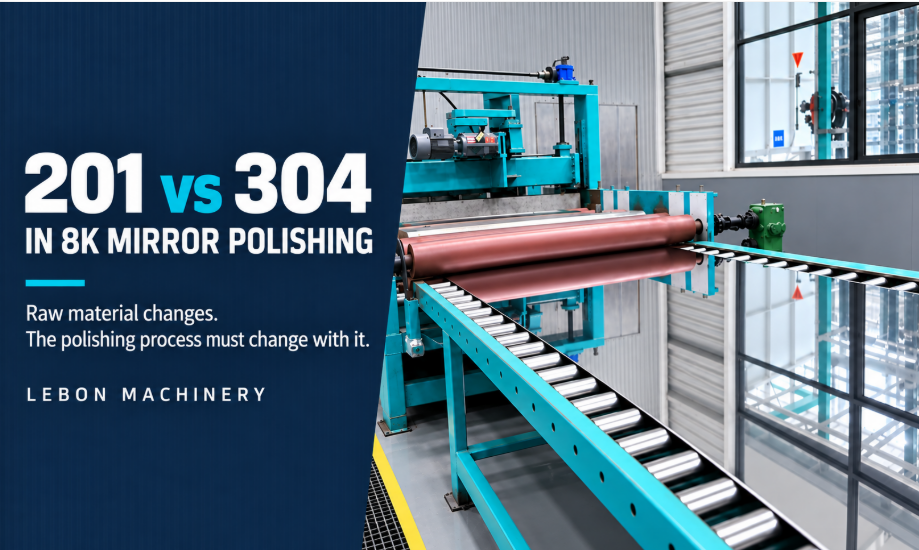
Both 201 and 304 stainless steel can be polished to an 8K mirror finish. The difference is not whether the material can become reflective, but how much process control is required to achieve a uniform, commercially acceptable surface.
Compared with 304, 201 stainless steel is generally harder and more sensitive to grinding heat and work hardening. It therefore places greater demands on the rough-polishing sequence, abrasive selection, cooling, grinding pressure and feed speed. If the same settings are used for both materials, the 201 sheet is more likely to retain micro-pits, develop haze or show uneven reflection after fine polishing.
201 stainless steel uses less nickel and more manganese than 304. This composition gives the two grades different forming and polishing behaviour. In production, 201 often feels harder to grind and may heat up faster under an unsuitable load. Once the surface becomes excessively hot, work hardening can reduce cutting efficiency and make a stable finish more difficult to achieve.
304 stainless steel has a more moderate hardness and is usually more forgiving during mirror polishing. It can often reach the required intermediate surface with a wider range of operating parameters. However, the incoming surface still matters: a poor 304 2B sheet with pits or rolling defects may require more preparation than a cleaner sheet.
Process factor | 201 stainless steel | 304 stainless steel |
Grinding behaviour | Generally harder to cut and more sensitive to work hardening. | Usually easier to grind and more tolerant of parameter changes. |
Heat control | Requires careful cooling and a balanced pressure-speed combination. | Still requires cooling, but normally has a wider stable process window. |
Rough polishing | More attention is needed to remove oxide, micro-pits and rolling defects without leaving deep marks. | Surface defects are often easier to remove, depending on the incoming 2B quality. |
Parameter setting | Lower or excessive pressure can both cause problems; sample-based adjustment is important. | Standard recipes are easier to establish, but should still be matched to thickness and surface condition. |
Typical risk | Cloudy appearance, whitish areas, retained pits or uneven brightness. | Residual rolling marks, local haze or polishing-head marks if preparation is insufficient. |
An 8K polishing line does not begin with a blank surface. It begins with the actual 2B or BA sheet supplied by the steel mill. BA material is already brighter and smoother, so it normally requires less corrective rough grinding. A 2B sheet may carry fine rolling texture, oxide, shallow pits or local surface variation that must be removed before mirror polishing.
This is especially important today because more processors are using 201 2B sheet as the raw material for 8K production. A line designed around cleaner BA or 304 material may not provide enough rough-polishing capacity when the incoming material changes. The machine configuration must follow the real raw material, not only the target finish.
The purpose of rough polishing is to remove defects while producing a sufficiently fine and uniform base for the mirror section. For 201 2B material, this stage usually requires a carefully planned grit sequence and enough working groups to separate heavy defect removal from surface refinement.
· Abrasives: Select the abrasive type and grit sequence according to the actual hardness and defect depth of the sheet.
· Pressure: Use enough load to cut the surface, but avoid excessive pressure that generates heat and accelerates work hardening.
· Feed speed: Match the line speed to the available grinding capacity; increasing speed without sufficient removal leaves defects for the fine-polishing section.
· Cooling: Deliver cooling liquid evenly to the active grinding zone to control temperature and remove grinding debris.
· Intermediate quality: Before fine polishing, aim for a clean and uniform surface around Ra 0.05 micrometres, subject to the agreed process and sample result.
Fine polishing with wool discs and a controlled polishing medium increases gloss and reduces surface roughness. It cannot reliably erase deep abrasive marks, retained pits or uneven removal left by the rough-polishing stage. Adding more fine-polishing heads may increase production capacity, but it does not replace correct surface preparation.
For both 201 and 304, the fine-polishing recipe should be adjusted to the material, incoming surface and required output. In a traditional process, aluminium oxide powder, water and nitric acid may be used in a controlled mixture. Acid-free mechanical polishing is also possible, but its achievable finish and production speed should be confirmed by sample testing.
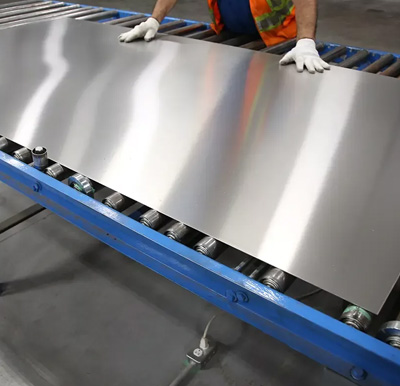
The final sheet should be checked with both instruments and visual inspection. A commonly used commercial reference is Ra below 0.02 micrometres and gloss of approximately 600 to 800 GU measured at 60 degrees. The exact acceptance range should be agreed with the buyer and verified with the same measurement method.
Under strong, even lighting, inspect the complete sheet for polishing-head arcs, swirl marks, haze, pits, colour variation and distorted reflection. Check the left, centre and right areas as well as the head, middle and tail of the sheet. A high gloss reading at one point does not prove that the entire surface is uniform.
304 is generally easier to polish and offers a wider process window. 201 can also achieve a high-quality 8K mirror finish, but it normally needs stronger rough-polishing capability and tighter control of heat, pressure and speed. The better choice depends on the product market, raw-material cost, corrosion requirements and the buyer's surface standard.
For a new project, the safest approach is to test the customer's actual sheets. Sample polishing reveals the true defect-removal requirement, suitable abrasive sequence, achievable gloss and Ra, and realistic production speed. This information is more useful than selecting the machine only by steel grade or thickness.
Yes. With suitable raw material and a correctly controlled process, 201 can reach a commercial 8K mirror finish. It normally requires more careful rough polishing and heat control.
Yes, provided the line has adequate rough-polishing capacity and adjustable recipes for abrasive selection, pressure, cooling and feed speed. The same settings should not be used automatically for both grades.
BA usually starts with a brighter and smoother surface, so it may require less corrective grinding. However, the final decision should consider material cost, availability, target finish and production economics.
Please, feel free to contact us if you need any further information.
Copyright © Lebon Metal Equipment Co., Ltd. All Rights Reserved.
Design by BONTOP.
 En
En