


Robot Polishing System
Industrial Mirror Polishing Buffing Machine
8K Mirror Polishing Machine for Stainless Steel | Eco-Friendly Acid-Free System
Aluminium Plate Coil Mirror Polishing Machine
6K Mirror Buffing Polishing Machine for Metal Surfaces
High-precision metal mirror polishing machine
Pneumatic-pressure 8K Mirror Polishing Machine
Belt-type 8K Mirror Stainless Steel Polishing Machine
High Gloss Mirror Buffing &Polishing Machine
No.8 8K Finishing Mirror Buffing Polishing Machine
Super 8K Mirror Polishing Machine
Industrial Metal Buffing Machine
Titanium Surface Mirror Buffing Machine
Coil To Coil No.4 Finished Grinding Line
Sheet To Sheet NO.4 Finished Grinding Line
Metal Coil Grinding Machine
Metal Sheet Brushing Machine
Copper Polishing Grinding Machine
Titanium Surface Polishing Brushing Machine
Aluminum Plate Polishing Brushing Machine
Stainless No.4 Grinding Machine
Belt Brushing & Grinding Machine
Stainless HL Grinding Machine
Roller HL Grinding Machine
Belt HL Brushing Machine
Dry HL Finishing Machine
Wet HL Finishing Machine
Dry No.4 &HL Grinding Machine Line
Wet No.4 &HL Brushing Machine Line
Scotch-Brite finished Machine For Metal Surface
Scotch-Brite Finished Machine
Stainless Steel Scotch Brite Polishing Machine
Wet Scotch Brite Machine Line
Fully Automatic Scotch Brite(SB) Machine Line
SB Oscillator Machine
SB Grinding Machine
Scotch Brite with Oscillator
Dry Scotch Brite Machine
Four roller Scotch Brite Grinding Machine
Thick Board Stainless Steel Vibration Grinding Machine
Vibration Grinding
Stainless Steel Vibration Grinding Machine
AFP machine
Anti-Fingerprint Roller Coater machine
Anti-Fingerprint Pre-coated machine
Anti-Fingerprint Film Coating machine
Anti-Fingerprint Nano-Coating machine
Precision Sheet Cutting Line for Decorative Metal Processing
Leveling and Precision Cutting Line for Metal Sheet Processing
Automatic Coil Uncoiling
FAQ
By:Lebon
Jul 27,2026
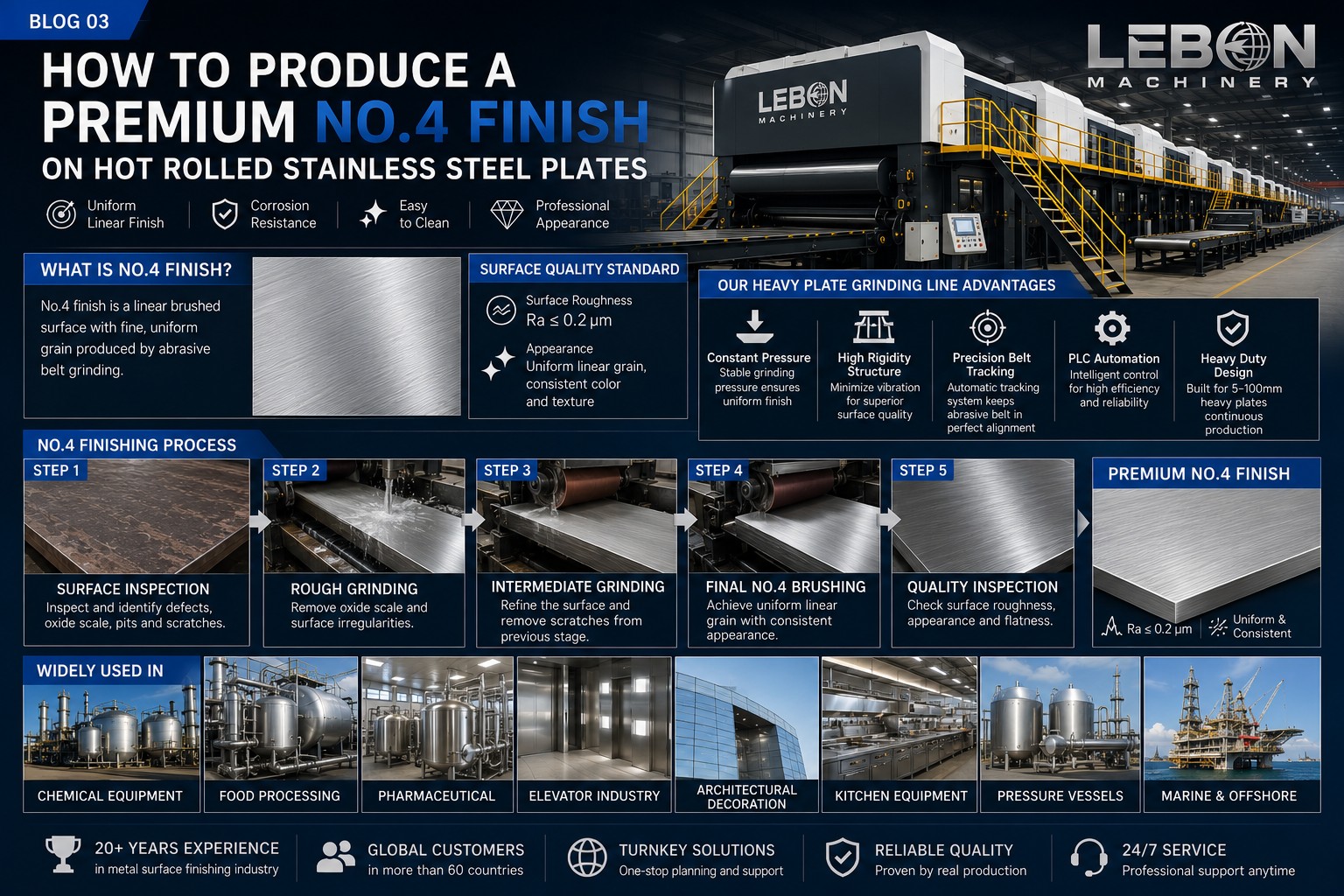
Among all industrial stainless steel surface finishes, No.4 Finish remains one of the most widely used.
Its uniform, straight grain provides an excellent balance between appearance, functionality, maintenance, and production cost.
While producing a No.4 finish on cold rolled sheets is relatively straightforward, achieving the same quality on hot rolled heavy plates is a much greater engineering challenge.
Hot rolled plates contain:
Mill scale
Surface waviness
Oxide layers
Minor pits
Rolling defects
All of these must be removed while maintaining flatness and creating a perfectly uniform grain.
At LEBON MACHINERY, we specialize in heavy-duty grinding solutions for stainless steel plates from 5 mm to 100 mm, helping manufacturers achieve premium No.4 finishes with stable quality and high productivity.
A No.4 finish is a linear brushed surface produced by abrasive belt grinding.
Unlike a mirror finish, it diffuses light rather than reflecting it directly.
A high-quality No.4 surface should feature:
Straight and uniform grain
Consistent color
No vibration marks
No chatter marks
No scratches
No blind polishing areas
The finish is widely used because it combines attractive appearance with excellent durability and easy maintenance.
Unlike decorative stainless steel sheets, hot rolled plates are manufactured for structural applications.
Their surfaces are much rougher before grinding.
Typical challenges include:
The thick oxide layer must be completely removed.
Large plates often contain slight deformation after rolling.
Grinding pressure must remain consistent across the entire width.
Minor pits and rolling marks become more visible after brushing if not removed during rough grinding.
Thicker plates require:
Higher grinding force
Stronger machine structure
Larger contact rollers
Stable feeding systems
Without sufficient rigidity, vibration marks quickly appear.
Before grinding begins, every plate should be inspected.
Engineers should identify:
Oxide scale
Weld marks
Surface pits
Scratches
Edge defects
Some localized defects may require manual preparation before entering the production line.
The first grinding stage removes:
Oxide scale
Surface irregularities
Rolling marks
Heavy stock removal creates a uniform base for the following grinding process.
Choosing the correct abrasive grit depends on:
Material grade
Plate thickness
Initial surface condition
Intermediate grinding reduces the roughness created during the previous stage.
Each grinding pass should remove the scratches produced by the earlier abrasive belt.
Stable pressure and feed speed are essential.
If pressure varies, grain consistency will be affected.
This stage determines the final appearance.
A premium No.4 finish should show:
✓ Straight grain
✓ Uniform texture
✓ Consistent color
✓ No vibration marks
✓ Excellent visual consistency
This is where machine precision becomes critical.
Grinding pressure directly influences:
Surface roughness
Grain consistency
Abrasive belt life
Production efficiency
Too much pressure causes:
Belt wear
Overheating
Surface burning
Too little pressure leaves:
Uneven grain
Poor cutting
Inconsistent appearance
LEBON's constant-pressure grinding technology helps maintain stable contact throughout the polishing process.
Different abrasive belts produce different textures.
Factors include:
Grit size
Belt hardness
Abrasive material
Grinding speed
Typical industrial production may use multiple grinding stages before the final No.4 belt.
Proper abrasive selection improves:
Surface quality
Belt life
Production cost
High-quality No.4 finishes cannot rely on abrasives alone.
The machine itself must provide:
To reduce vibration.
To eliminate chatter marks.
To ensure stable abrasive movement.
For consistent grinding quality.
To improve repeatability and production efficiency.
Premium No.4 finishes are widely used in:
Mixing tanks
Pressure vessels
Heat exchangers
Processing equipment
Storage tanks
Sanitary systems
Decorative stainless steel panels
Door frames
Interior components
Building facades
Interior wall panels
Public facilities
Commercial kitchens
Food preparation equipment
Restaurant equipment
Producing a premium No.4 finish requires more than a polishing machine.
LEBON combines:
Equipment manufacturing
Real production facilities
Heavy plate grinding experience
Continuous process optimization
Our own grinding lines allow us to verify machine performance under real production conditions before delivery.
This practical experience helps customers achieve:
Higher efficiency
Better surface consistency
Lower operating costs
Longer abrasive life
No.4 has a shorter, finer grain with a softer appearance.
Hairline finishes feature longer continuous lines and are mainly used for decorative applications.
Yes.
With proper grinding technology and stable equipment, heavy plates can achieve premium industrial and decorative No.4 surfaces.
Common causes include:
Poor machine rigidity
Unbalanced rollers
Incorrect grinding pressure
Worn abrasive belts
LEBON specializes in heavy plate grinding and polishing solutions backed by real production experience.
Our machines are continuously optimized through practical manufacturing rather than laboratory testing alone.
Producing a premium No.4 finish on hot rolled stainless steel plates requires the perfect combination of material preparation, abrasive selection, machine rigidity, constant pressure control, and production experience.
At LEBON MACHINERY, we help manufacturers around the world achieve consistent, high-quality No.4 finishes through advanced grinding technology and practical process expertise.
Whether your application is chemical processing, food equipment, architecture, or industrial manufacturing, LEBON provides reliable solutions designed for long-term performance.
Contact LEBON MACHINERY to discuss your material grade, plate thickness, surface finish requirements, and production capacity. Our engineering team will recommend the most suitable No.4 grinding and brushing solution for your project.
Please, feel free to contact us if you need any further information.
Copyright © Lebon Metal Equipment Co., Ltd. All Rights Reserved.
Design by BONTOP.
 En
En