


Robot Polishing System
Industrial Mirror Polishing Buffing Machine
8K Mirror Polishing Machine for Stainless Steel | Eco-Friendly Acid-Free System
Aluminium Plate Coil Mirror Polishing Machine
6K Mirror Buffing Polishing Machine for Metal Surfaces
High-precision metal mirror polishing machine
Pneumatic-pressure 8K Mirror Polishing Machine
Belt-type 8K Mirror Stainless Steel Polishing Machine
High Gloss Mirror Buffing &Polishing Machine
No.8 8K Finishing Mirror Buffing Polishing Machine
Super 8K Mirror Polishing Machine
Industrial Metal Buffing Machine
Titanium Surface Mirror Buffing Machine
Coil To Coil No.4 Finished Grinding Line
Sheet To Sheet NO.4 Finished Grinding Line
Metal Coil Grinding Machine
Metal Sheet Brushing Machine
Copper Polishing Grinding Machine
Titanium Surface Polishing Brushing Machine
Aluminum Plate Polishing Brushing Machine
Stainless No.4 Grinding Machine
Belt Brushing & Grinding Machine
Stainless HL Grinding Machine
Roller HL Grinding Machine
Belt HL Brushing Machine
Dry HL Finishing Machine
Wet HL Finishing Machine
Dry No.4 &HL Grinding Machine Line
Wet No.4 &HL Brushing Machine Line
Scotch-Brite finished Machine For Metal Surface
Scotch-Brite Finished Machine
Stainless Steel Scotch Brite Polishing Machine
Wet Scotch Brite Machine Line
Fully Automatic Scotch Brite(SB) Machine Line
SB Oscillator Machine
SB Grinding Machine
Scotch Brite with Oscillator
Dry Scotch Brite Machine
Four roller Scotch Brite Grinding Machine
Thick Board Stainless Steel Vibration Grinding Machine
Vibration Grinding
Stainless Steel Vibration Grinding Machine
AFP machine
Anti-Fingerprint Roller Coater machine
Anti-Fingerprint Pre-coated machine
Anti-Fingerprint Film Coating machine
Anti-Fingerprint Nano-Coating machine
Precision Sheet Cutting Line for Decorative Metal Processing
Leveling and Precision Cutting Line for Metal Sheet Processing
Automatic Coil Uncoiling
FAQ
By:Lebon
Jul 27,2026
Choosing the right stainless steel surface finish is just as important as selecting the correct material grade.
Whether you process 304, 316L, 2205 Duplex, or other stainless steel alloys, the surface finish directly affects product appearance, corrosion resistance, cleanability, maintenance costs, and even production efficiency.
Among all industrial finishes, Mirror Finish and No.4 Finish are the two most commonly specified.
Although they are both produced by grinding and polishing, they are designed for very different applications.
In this guide, we compare their characteristics, manufacturing processes, advantages, and ideal applications to help manufacturers make the right decision.
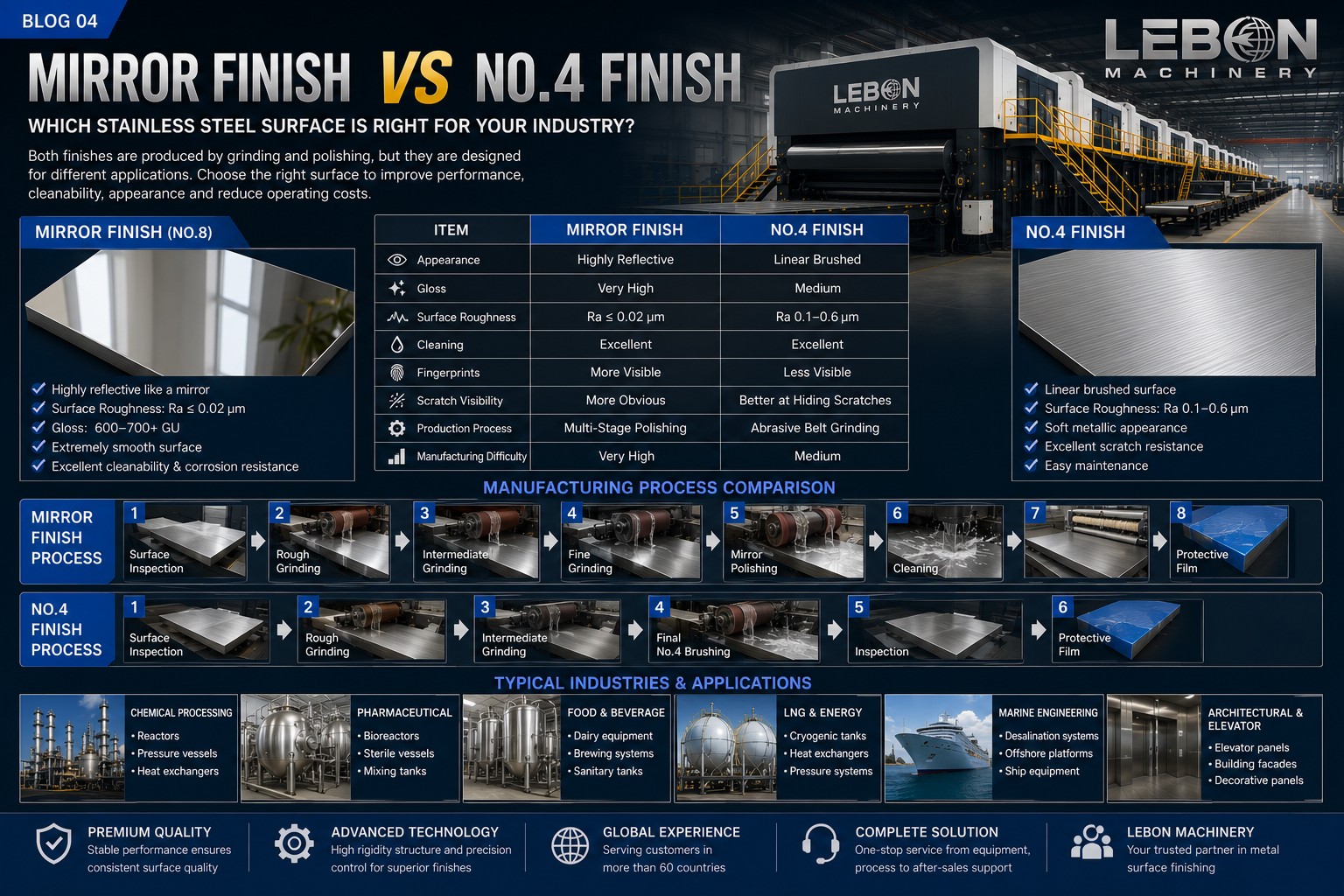
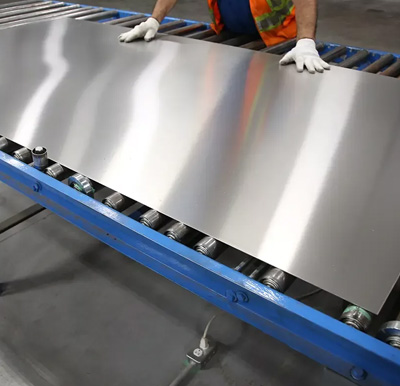
Mirror Finish (also called No.8 Mirror Finish) is a highly polished surface capable of producing clear reflections.
Industrial mirror polishing normally consists of multiple grinding and polishing stages until surface roughness reaches extremely low values.
Typical specifications include:
Surface Roughness: Ra ≤ 0.02 μm
Gloss: 600–700+ GU
Nearly distortion-free reflection
Extremely smooth surface
Because the surface contains almost no microscopic grooves, it offers excellent cleanability and corrosion resistance.
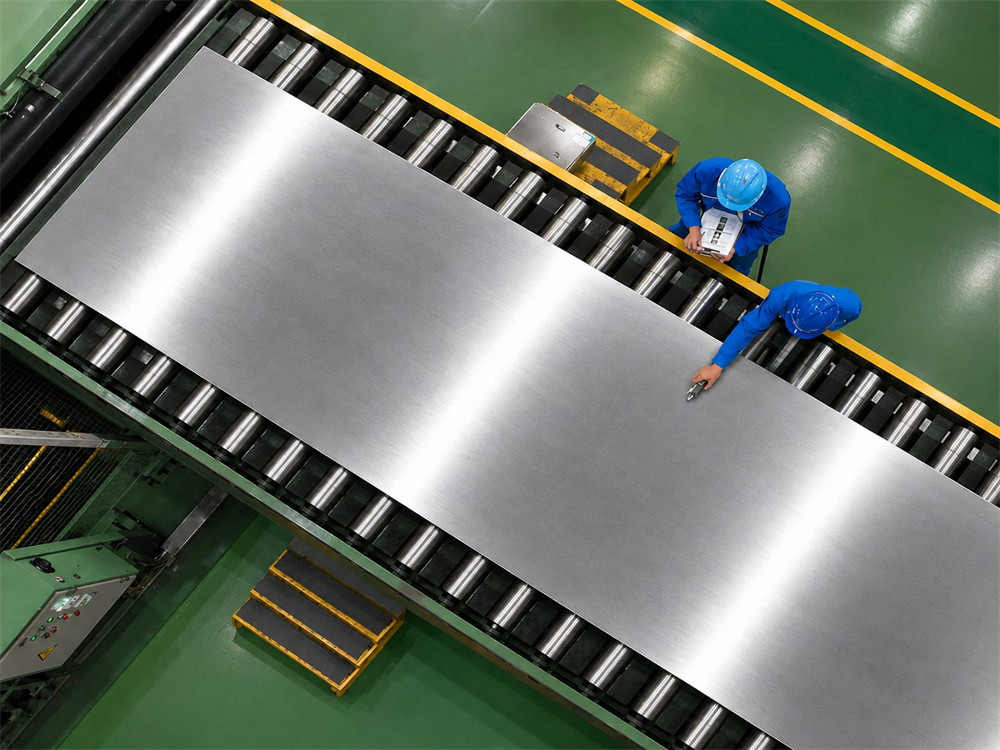
No.4 Finish is produced by abrasive belt grinding.
Instead of reflecting light like a mirror, it creates a uniform linear grain.
Typical characteristics include:
Straight brushed texture
Soft metallic appearance
Low reflection
Excellent scratch resistance
Easy maintenance
Rather than hiding scratches completely, No.4 Finish makes minor scratches much less noticeable during daily use.
Item | Mirror Finish | No.4 Finish |
Appearance | Highly reflective | Linear brushed |
Gloss | Very High | Medium |
Surface Roughness | Ra ≤ 0.02 μm | Typically Ra 0.1–0.6 μm |
Cleaning | Excellent | Excellent |
Fingerprints | More visible | Less visible |
Scratch Visibility | More obvious | Better at hiding scratches |
Production Process | Multi-stage polishing | Abrasive belt grinding |
Manufacturing Difficulty | Very High | Medium |
Typical process:
Surface Inspection
↓
Rough Grinding
↓
Intermediate Grinding
↓
Fine Grinding
↓
Mirror Polishing
↓
Cleaning
↓
Drying
↓
Protective Film
Each polishing stage removes scratches left by the previous stage.
Any vibration, unstable pressure, or abrasive inconsistency may become visible in the final mirror surface.
The production process is simpler.
Surface Inspection
↓
Rough Grinding
↓
Intermediate Grinding
↓
Final No.4 Brushing
↓
Inspection
↓
Protective Film
Although fewer polishing stages are required, maintaining a perfectly uniform grain across large heavy plates still demands stable grinding pressure and precise machine control.
Mirror polishing is widely used where cleanliness and corrosion resistance are essential.
Typical industries include:
Reaction vessels
Pressure tanks
Heat exchangers
Bioreactors
Sterile vessels
Mixing tanks
Dairy equipment
Brewing systems
Sanitary tanks
Cryogenic equipment
Pressure vessels
Hydrogen storage
Vacuum chambers
Copper foil production equipment
Precision process systems
No.4 Finish is commonly selected where durability and appearance must be balanced.
Applications include:
Elevator panels
Building facades
Kitchen equipment
Architectural decoration
Commercial furniture
Industrial machinery
Transportation equipment
Because the brushed grain hides daily wear better than mirror surfaces, it is ideal for high-contact environments.
Both finishes are easy to clean.
However, their maintenance characteristics differ.
Mirror Finish:
Advantages
✓ Extremely hygienic
✓ Smoothest surface
✓ Lowest contamination
Disadvantages
× Fingerprints are more visible
× Surface scratches are easier to notice
No.4 Finish
Advantages
✓ Better scratch resistance
✓ Fingerprints less noticeable
✓ Lower maintenance frequency
Disadvantages
× Linear grain may trap contaminants if poorly finished
Therefore, surface quality—not simply the finish type—is critical.
Whether producing Mirror Finish or No.4 Finish, surface consistency depends heavily on equipment performance.
Key factors include:
High-rigidity machine frame
Precision contact rollers
Constant grinding pressure
Stable abrasive belt tracking
PLC automation
Accurate feed speed control
Even the best abrasive belts cannot compensate for poor machine stability.
LEBON MACHINERY provides complete surface finishing solutions for:
Mirror Finish
No.4 Finish
Hairline Finish
Scotch-Brite Finish
Anti-Fingerprint (AFP)
Our heavy-duty grinding and polishing systems process hot rolled stainless steel plates from 5 mm to 100 mm, helping customers produce premium surfaces for industrial and decorative applications.
Unlike many equipment manufacturers, LEBON also operates its own production lines, allowing continuous equipment optimization based on real manufacturing experience.
No.
The best finish depends on the application.
Mirror Finish is ideal for hygienic environments, while No.4 Finish is often preferred where scratch resistance and everyday durability are more important.
Yes.
Modern grinding and polishing systems can produce both premium No.4 and Mirror finishes on hot rolled stainless steel plates.
Mirror Finish generally requires more polishing stages, longer production time, and tighter process control, making it more expensive.
We recommend selecting the finish according to your product application, material grade, customer requirements, and production objectives. Our engineering team provides complete process recommendations rather than simply supplying equipment.
Mirror Finish and No.4 Finish each offer unique advantages.
Mirror polishing delivers exceptional cleanliness, corrosion resistance, and visual quality, making it ideal for chemical, pharmaceutical, food, semiconductor, and energy industries.
No.4 Finish provides a durable, attractive brushed appearance that is widely used in elevators, architecture, commercial kitchens, and industrial equipment.
At LEBON MACHINERY, we help manufacturers produce both finishes with stable quality through advanced grinding technology, precision engineering, and years of practical production experience.
Whether your project requires a flawless mirror surface or a premium No.4 brushed finish, our complete surface finishing solutions are designed to maximize quality, efficiency, and long-term reliability.
Contact LEBON MACHINERY today. Our engineering team will recommend the most suitable grinding and polishing solution based on your material, thickness, production capacity, and target surface finish.
Please, feel free to contact us if you need any further information.
Copyright © Lebon Metal Equipment Co., Ltd. All Rights Reserved.
Design by BONTOP.
 En
En