


Robot Polishing System
Industrial Mirror Polishing Buffing Machine
8K Mirror Polishing Machine for Stainless Steel | Eco-Friendly Acid-Free System
Aluminium Plate Coil Mirror Polishing Machine
6K Mirror Buffing Polishing Machine for Metal Surfaces
High-precision metal mirror polishing machine
Pneumatic-pressure 8K Mirror Polishing Machine
Belt-type 8K Mirror Stainless Steel Polishing Machine
High Gloss Mirror Buffing &Polishing Machine
No.8 8K Finishing Mirror Buffing Polishing Machine
Super 8K Mirror Polishing Machine
Industrial Metal Buffing Machine
Titanium Surface Mirror Buffing Machine
Coil To Coil No.4 Finished Grinding Line
Sheet To Sheet NO.4 Finished Grinding Line
Metal Coil Grinding Machine
Metal Sheet Brushing Machine
Copper Polishing Grinding Machine
Titanium Surface Polishing Brushing Machine
Aluminum Plate Polishing Brushing Machine
Stainless No.4 Grinding Machine
Belt Brushing & Grinding Machine
Stainless HL Grinding Machine
Roller HL Grinding Machine
Belt HL Brushing Machine
Dry HL Finishing Machine
Wet HL Finishing Machine
Dry No.4 &HL Grinding Machine Line
Wet No.4 &HL Brushing Machine Line
Scotch-Brite finished Machine For Metal Surface
Scotch-Brite Finished Machine
Stainless Steel Scotch Brite Polishing Machine
Wet Scotch Brite Machine Line
Fully Automatic Scotch Brite(SB) Machine Line
SB Oscillator Machine
SB Grinding Machine
Scotch Brite with Oscillator
Dry Scotch Brite Machine
Four roller Scotch Brite Grinding Machine
Thick Board Stainless Steel Vibration Grinding Machine
Vibration Grinding
Stainless Steel Vibration Grinding Machine
AFP machine
Anti-Fingerprint Roller Coater machine
Anti-Fingerprint Pre-coated machine
Anti-Fingerprint Film Coating machine
Anti-Fingerprint Nano-Coating machine
Precision Sheet Cutting Line for Decorative Metal Processing
Leveling and Precision Cutting Line for Metal Sheet Processing
Automatic Coil Uncoiling
FAQ
By:Lebon
Jul 27,2026
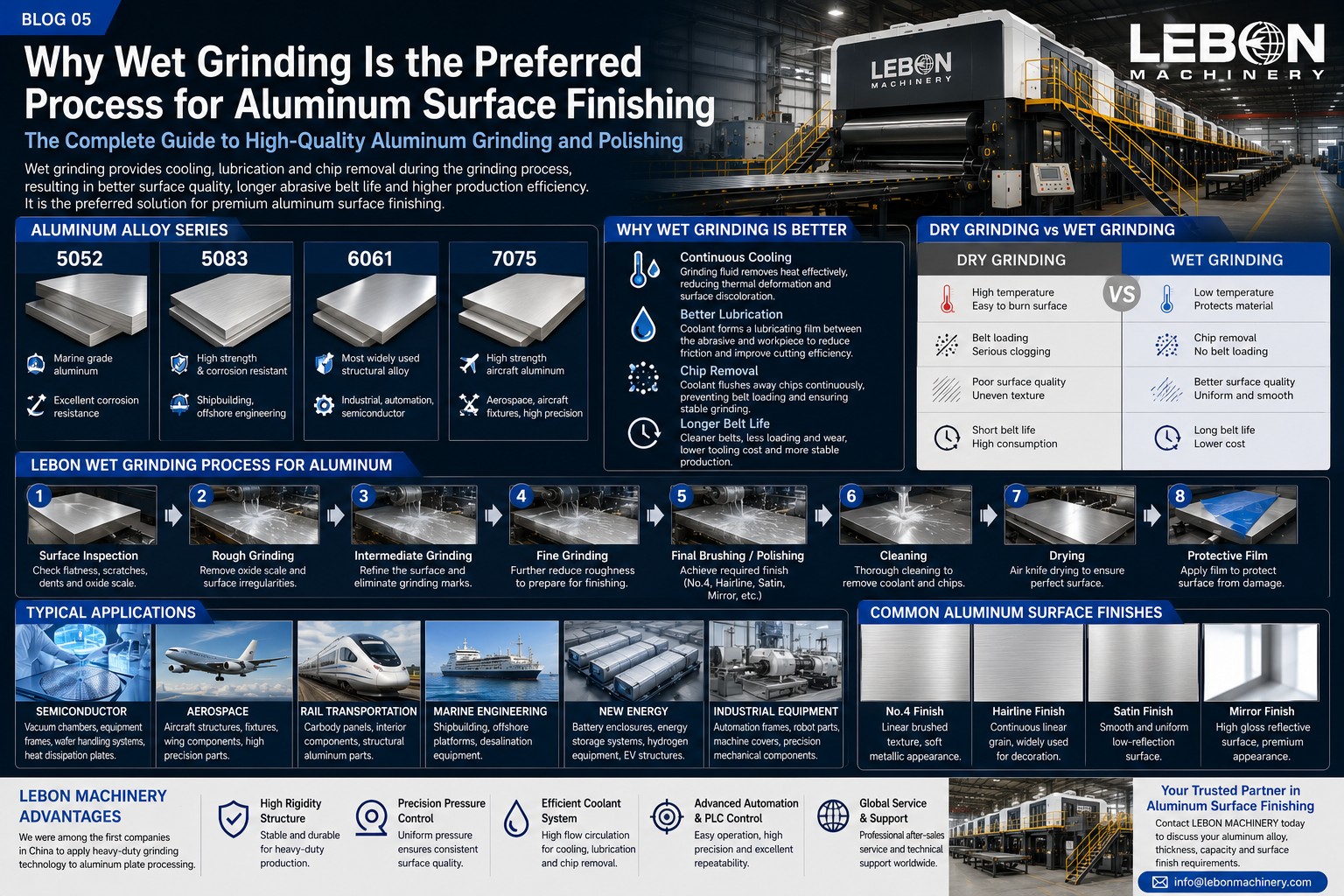
Aluminum has become one of the fastest-growing engineering materials in modern manufacturing.
From new energy battery systems and semiconductor equipment to aerospace structures, rail transportation, and marine engineering, aluminum alloys are replacing steel in many applications because of their lightweight, corrosion resistance, and excellent machinability.
However, aluminum presents unique challenges during surface finishing.
Unlike stainless steel, aluminum is softer, has a lower melting point, and tends to generate sticky chips during grinding. These characteristics make dry grinding difficult and often lead to poor surface quality.
For this reason, wet grinding has become the preferred process for aluminum surface finishing across many industries.
At LEBON MACHINERY, we were among the first companies in China to apply heavy-duty grinding technology to aluminum plate processing. Through years of equipment development and practical production experience, we have helped manufacturers achieve stable, high-quality aluminum surface finishes with greater efficiency.
Many people assume aluminum is easier to process simply because it is softer than stainless steel.
In reality, aluminum introduces several challenges during grinding.
Heat builds up quickly during dry grinding.
Excessive temperature can cause:
Surface burning
Material smearing
Belt loading
Poor surface consistency
Unlike stainless steel chips, aluminum chips easily adhere to abrasive belts.
This phenomenon is known as belt loading.
Once the abrasive surface becomes clogged, grinding efficiency decreases rapidly.
Because aluminum is relatively soft, unstable grinding pressure may produce:
Uneven material removal
Surface waviness
Inconsistent texture
Edge deformation
These characteristics require much more precise process control than many manufacturers expect.
Wet grinding solves several problems simultaneously.
Grinding fluid removes heat from both the abrasive belt and the workpiece.
Lower temperatures reduce:
Thermal deformation
Surface discoloration
Material sticking
The coolant forms a lubricating film between the abrasive and the aluminum surface.
This reduces friction and improves cutting efficiency.
Because aluminum chips are continuously washed away, abrasive belts remain cleaner.
Manufacturers benefit from:
Longer belt life
Lower tooling costs
More stable production
Wet grinding produces:
More uniform texture
Lower surface roughness
Better gloss consistency
Reduced vibration marks
For high-end aluminum applications, these improvements are essential.
Not all aluminum behaves the same.
Different alloys require different grinding parameters.
Marine-grade aluminum.
Excellent corrosion resistance.
Typical applications:
Shipbuilding
Offshore engineering
Desalination equipment
Battery enclosures
These alloys require stable grinding to maintain flatness while preserving corrosion resistance.
One of the world's most widely used structural aluminum alloys.
Applications include:
Industrial machinery
Automation equipment
Photovoltaic systems
Semiconductor equipment
Tooling plates
6061 offers an excellent balance between strength and machinability, making it ideal for precision surface finishing.
Known as "aircraft aluminum."
This high-strength alloy is widely used in:
Aerospace
Aircraft fixtures
High-precision tooling
Military equipment
Because of its hardness, 7075 requires higher grinding stability and more precise pressure control than softer aluminum alloys.
Different industries require different finishes.
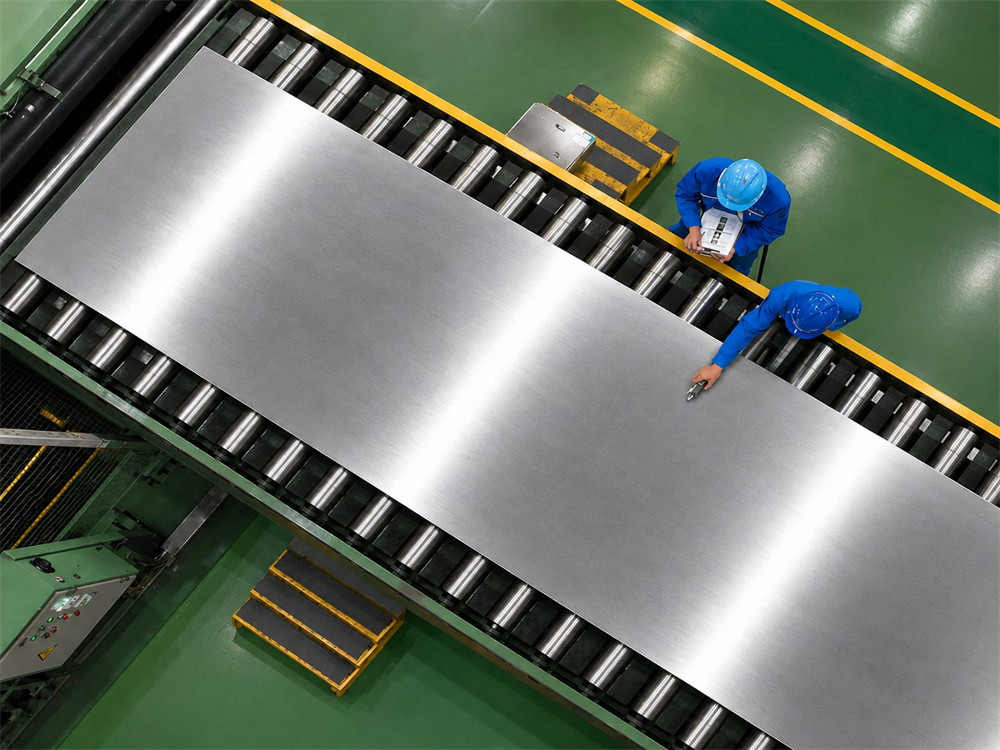
A fine linear texture suitable for architectural panels and industrial equipment.
A continuous brushed texture often used for decorative products.
A smooth, low-reflection finish popular in consumer electronics.
High-gloss polishing used in premium decorative products, optical applications, and semiconductor equipment.
Precision aluminum plates are widely used for:
Vacuum chambers
Equipment frames
Wafer handling systems
Heat dissipation plates
Surface quality directly influences equipment cleanliness and stability.
Aluminum plays an important role in:
Battery packs
Energy storage systems
Hydrogen equipment
Electric vehicle structures
Manufacturers require lightweight materials with excellent surface consistency.
Aircraft manufacturers demand:
High dimensional accuracy
Stable surface quality
Excellent fatigue resistance
Grinding quality directly affects subsequent anodizing and machining processes.
Large aluminum plates are used for:
High-speed trains
Metro systems
Vehicle structures
Uniform brushed finishes improve appearance while maintaining corrosion resistance.
Producing premium aluminum surfaces requires more than simply adding coolant.
A professional wet grinding system should include:
Maintains uniform grinding force.
Continuously removes chips and heat.
Ensures stable abrasive alignment.
Reduces vibration and improves surface consistency.
Guarantees repeatable production quality.
At LEBON MACHINERY, aluminum surface finishing is one of our core technologies.
Unlike general-purpose polishing machines, our wet grinding systems are specifically designed for aluminum processing.
Our solutions support:
Aluminum plates
Aluminum coils
5xxx Series
6xxx Series
7xxx Series
Applications include:
Aerospace
Semiconductor
Battery manufacturing
Marine engineering
Rail transportation
Industrial equipment
By combining advanced grinding technology with real production experience, we help customers achieve superior surface quality while reducing operating costs.
Wet grinding provides cooling, lubrication, and chip removal, resulting in better surface quality and longer abrasive belt life.
6061 is generally considered the easiest aluminum alloy to machine and polish due to its balanced mechanical properties.
Yes.
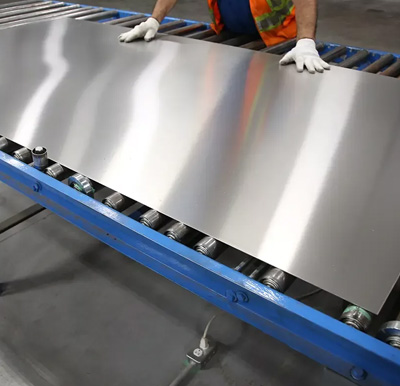
With proper grinding and polishing processes, aluminum plates can achieve high-quality mirror finishes suitable for decorative and industrial applications.
LEBON combines equipment manufacturing with practical aluminum processing experience, allowing continuous optimization of machine performance based on real production conditions.
As aluminum continues to replace traditional materials in aerospace, semiconductor, marine, and new energy industries, manufacturers are placing greater emphasis on surface quality.
Wet grinding has become the preferred solution because it improves cooling, extends abrasive life, enhances surface consistency, and reduces production costs.
At LEBON MACHINERY, we are committed to delivering advanced aluminum grinding and polishing solutions that combine intelligent equipment design with years of practical manufacturing experience.
Whether you process 5052, 5083, 6061, or 7075 aluminum, our engineering team can help you achieve premium surface finishes with reliable, efficient production.
Contact LEBON MACHINERY to discuss your aluminum alloy, thickness, production capacity, and required surface finish. We will help you build a customized wet grinding and polishing solution for your application.
Please, feel free to contact us if you need any further information.
Copyright © Lebon Metal Equipment Co., Ltd. All Rights Reserved.
Design by BONTOP.
 En
En