


Robot Polishing System
Industrial Mirror Polishing Buffing Machine
8K Mirror Polishing Machine for Stainless Steel | Eco-Friendly Acid-Free System
Aluminium Plate Coil Mirror Polishing Machine
6K Mirror Buffing Polishing Machine for Metal Surfaces
High-precision metal mirror polishing machine
Pneumatic-pressure 8K Mirror Polishing Machine
Belt-type 8K Mirror Stainless Steel Polishing Machine
High Gloss Mirror Buffing &Polishing Machine
No.8 8K Finishing Mirror Buffing Polishing Machine
Super 8K Mirror Polishing Machine
Industrial Metal Buffing Machine
Titanium Surface Mirror Buffing Machine
Coil To Coil No.4 Finished Grinding Line
Sheet To Sheet NO.4 Finished Grinding Line
Metal Coil Grinding Machine
Metal Sheet Brushing Machine
Copper Polishing Grinding Machine
Titanium Surface Polishing Brushing Machine
Aluminum Plate Polishing Brushing Machine
Stainless No.4 Grinding Machine
Belt Brushing & Grinding Machine
Stainless HL Grinding Machine
Roller HL Grinding Machine
Belt HL Brushing Machine
Dry HL Finishing Machine
Wet HL Finishing Machine
Dry No.4 &HL Grinding Machine Line
Wet No.4 &HL Brushing Machine Line
Scotch-Brite finished Machine For Metal Surface
Scotch-Brite Finished Machine
Stainless Steel Scotch Brite Polishing Machine
Wet Scotch Brite Machine Line
Fully Automatic Scotch Brite(SB) Machine Line
SB Oscillator Machine
SB Grinding Machine
Scotch Brite with Oscillator
Dry Scotch Brite Machine
Four roller Scotch Brite Grinding Machine
Thick Board Stainless Steel Vibration Grinding Machine
Vibration Grinding
Stainless Steel Vibration Grinding Machine
AFP machine
Anti-Fingerprint Roller Coater machine
Anti-Fingerprint Pre-coated machine
Anti-Fingerprint Film Coating machine
Anti-Fingerprint Nano-Coating machine
Precision Sheet Cutting Line for Decorative Metal Processing
Leveling and Precision Cutting Line for Metal Sheet Processing
Automatic Coil Uncoiling
Metal Surface Finishing Equipment Industry News
By:Lebon
Sep 29,2026
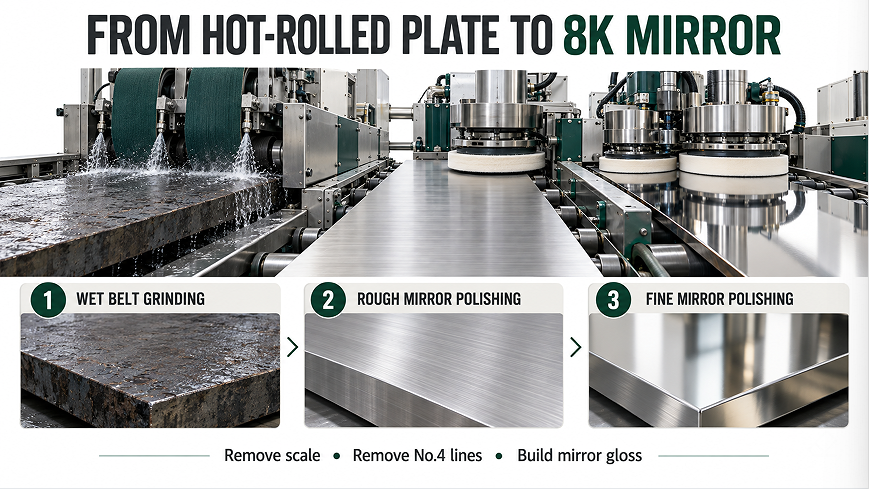
For stainless steel plates thicker than 5 mm, a good mirror finish starts well before the mirror polishing machine. Hot-rolled plate typically arrives with oxide scale and surface irregularities. If these are left for the mirror polishing heads to remove, polishing becomes slower and No.4 lines or head marks may remain visible in the final surface.
A heavy-duty wet belt grinding machine removes the hot-rolled oxide layer and creates a more uniform surface. This is the No.4 preparation stage. For the project described here, the target after grinding is Ra ≤ 0.2 μm.
The plate is now ready for mirror polishing, but it is not yet a mirror surface. The No.4 stage leaves directional grinding lines that must be removed progressively in the next stage.
For 6 m long hot-rolled plates, our engineers estimate the following daily output from a two-head wet belt grinding line:
| Plate thickness | Estimated output |
|---|---|
| 3–8 mm | 50–80 plates/day |
| 9–15 mm | 30–40 plates/day |
| 16–25 mm | 15–20 plates/day |
| 26–40 mm | 10–15 plates/day |
These are project estimates. Actual output depends on oxide scale, plate flatness, the required material removal, abrasive condition and operating hours.
Rough mirror polishing is the bridge between No.4 grinding and the final 8K finish. Successive rough polishing groups use progressively finer abrasives to remove the directional No.4 lines and reduce surface roughness further. For this process, our engineers recommend aiming for approximately Ra 0.05 μm after rough polishing, before the fine polishing groups raise the gloss.
If there are too few rough polishing groups, operators may have to reduce the feed speed to remove the No.4 lines. Otherwise, residual lines or polishing-head marks can remain. Fine polishing improves reflectivity, but it should not be expected to compensate for incomplete rough polishing.
A four-rough + two-fine configuration can process properly prepared hot-rolled plates. For 6 m plates, the estimated output of a six-group line is approximately 14–16 plates per day, depending on the incoming surface and finish requirement.
Where higher throughput is needed, our engineers recommend five rough groups + three fine groups. The additional rough group provides more capacity to remove No.4 lines, while the additional fine group supports the final gloss at a higher feed speed. Based on our processing experience, this configuration may run more than 30% faster than a four-rough + two-fine arrangement under comparable conditions. The actual difference should be verified with representative customer plates.
For thick hot-rolled stainless steel, the two machines perform different jobs:
Wet belt grinding removes oxide scale and establishes a uniform No.4 base. Rough mirror polishing removes the No.4 lines. Fine polishing develops the final mirror appearance and gloss.
Selecting the polishing line without considering the quality of the incoming No.4 surface can lead to slower production or visible defects. The most reliable configuration starts with the plate condition, the target finish and a trial using representative material.
Please, feel free to contact us if you need any further information.
Copyright © Lebon Metal Equipment Co., Ltd. All Rights Reserved.
Design by BONTOP.
 En
En